

Key Takeaways
- SAN storage centralizes high-speed data access, enabling seamless performance and organizational scalability.
- Integration of AI and modern protocols, such as NVMe, ensures that SAN technologies remain relevant and powerful for today’s enterprises.
- Success with SAN solutions starts with strategic planning and thorough assessment of existing and future requirements.
Table of Contents
- Understanding SAN Storage
- Benefits of SAN Storage for Enterprises
- Technological Advancements in SAN Solutions
- Implementing SAN Storage in Your Organization
- Conclusion
The efficient management of mission-critical data requires more than just ample storage capacity. Organizations must ensure their infrastructure keeps pace with technological advances and ever-increasing workloads while safeguarding vital information against disruptions. SAN storage plays a pivotal role in this equation by enhancing both performance and reliability for enterprise operations.
Understanding SAN Storage
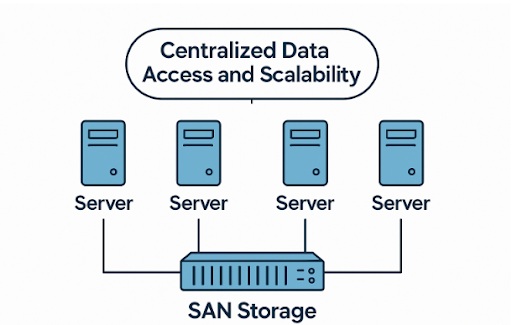
By decoupling storage from compute resources, SANs enable dynamic allocation and simpler expansion of storage capacity, which are crucial for adapting to changing business needs. The architecture often employs Fibre Channel or iSCSI protocols, which help maintain high throughput and low latency suitable for data-intensive enterprise applications.
One noteworthy aspect of SAN storage is its ability to offer granular control over data traffic, ensuring high-priority applications receive the bandwidth they require while supporting diverse workloads without compromise. In addition to allowing multiple hosts to access the same storage resources, SAN architectures can be built to span geographically dispersed data centers, further enhancing both fault tolerance and business continuity. Advanced SAN monitoring and management software provides deep visibility into storage utilization, resource performance, and health status, enabling IT teams to proactively resolve bottlenecks or failures before they escalate into service disruptions.
Benefits of SAN Storage for Enterprises
Adopting a SAN framework brings a wide range of benefits that address the pressing requirements of large and midsize organizations:
- High Performance: SANs offer unrivaled data transfer speeds, supporting high-performance computing, virtualized environments, and transactional databases.
- Scalability: It is easy to expand storage on demand without disrupting core operations, making SANs ideal for businesses facing unpredictable data growth.
- Centralized Management: Administrators can centrally manage storage, streamlining routine maintenance, optimizing resource allocation, and enhancing overall security.
- Enhanced Data Protection: SAN solutions often come with robust features for backup, data replication, and disaster recovery, helping businesses meet compliance mandates and minimize risk to critical data.
Additionally, SANs bolster an organization’s compliance posture by supporting sophisticated access control policies, auditing capabilities, and safeguarding sensitive records. Their integration within virtualized or hybrid cloud environments also makes them attractive for companies pursuing digital transformation. SANs help bridge on-premises operations with cloud resources, enabling businesses to easily support both legacy and next-generation workloads.
Technological Advancements in SAN Solutions
Modern SAN platforms are incorporating a wave of technological enhancements that bring even greater value. Artificial Intelligence (AI) and Machine Learning (ML) are increasingly common, providing predictive analytics and automated optimization of storage resources. For example, certain solutions analyze workloads in real time, automatically balancing performance and identifying potential bottlenecks before they affect users.
The adoption of Non-Volatile Memory Express (NVMe) technology, particularly in SAN environments, has dramatically improved I/O performance and reduced latency. NVMe enables direct storage access over high-speed fabrics, facilitating faster data processing vital for analytics, virtualization, and AI workloads. This technology evolution future-proofs the SAN investment while granting organizations a path toward even greater operational efficiency.
Furthermore, software-defined storage (SDS) solutions are redefining SAN deployment by decoupling storage services from proprietary hardware. This approach allows organizations to manage heterogeneous storage pools under a unified control plane, resulting in cost savings and increased deployment flexibility. With ongoing innovation in storage automation and orchestration, enterprises can now quickly adapt to shifting needs and maximize resource utilization across their IT environments.
Implementing SAN Storage in Your Organization
Deploying SAN storage requires a measured approach to align technology with organizational goals:
- Assess Current Infrastructure: Audit your existing storage assets to pinpoint inefficiencies and capacity constraints. Understanding current architecture is essential for effective SAN integration.
- Define Storage Requirements: Evaluate both immediate and anticipated needs related to data volume, application workloads, and performance expectations. Accurate forecasting helps avoid future bottlenecks.
- Select the Right SAN Technology: Choose between Fibre Channel, iSCSI, or emerging NVMe-over-Fabrics based on latency, throughput, and organizational budget considerations. Each protocol offers unique trade-offs.
- Plan System Integration: SAN deployment must be compatible with your network, servers, and existing data protection frameworks. Carefully plan for minimal downtime and seamless migration.
- More guidance on: IT infrastructure planning is available at the CIO’s guide on tracking cost allocation for cloud apps.
- Implement Data Protection: Establish strong backup, replication, and disaster recovery processes to secure data against loss or corruption. The resilience of your data management environment will depend on this step.
Finally, staff training and continuous process optimization are essential to fully realize the value of a SAN deployment. Developing internal expertise in SAN management, along with monitoring evolving industry standards and security best practices, will help organizations stay ahead of the curve and respond swiftly to new technological opportunities or risks. Collaboration among IT, compliance, and operations teams is key to ensuring the SAN infrastructure scales and adapts as business priorities and regulatory landscapes evolve.
Conclusion
Managing enterprise data efficiently is both a technical necessity and an indispensable driver of competitive advantage. As organizations generate, store, and analyze unprecedented amounts of information, forward-thinking businesses are adopting SAN storage to provide the high performance, scalability, and reliability modern operations demand. Leading storage providers, such as Nfina, now offer a broad array of SAN solutions that balance workload-intensive environments with cost-effective data protection strategies.
By staying informed about the advances in SAN technologies and taking a strategic approach to deployment, organizations can optimize their data management capabilities, protect mission-critical assets, and support growth in an era defined by the exponential value of data.