

Key Takeaways
- Modern organization design enhances adaptability and resilience in businesses.
- Decentralized structures empower teams and expedite decision-making.
- Integrating digital technologies strengthens organizational resilience.
- Continuous adaptation and learning are essential for sustained success.
Table of Contents
- Decentralized Structures: Enhancing Agility
- Integrating Digital Technologies for Resilience
- Continuous Adaptation and Learning
- Case Study: VARIUS GROUP’s Strategic Reinvention
- Conclusion
In today’s relentlessly evolving market, the ability for an organization to quickly adapt can determine its long-term success or failure. Businesses that thoughtfully embrace modern organization design not only enhance their responsiveness but also strengthen their capacity to weather uncertainty. The guidance of an experienced organizational design consultant can help companies structure themselves for greater agility, fostering a culture that is primed for continual reinvention and growth.
Flexibility in design is vital for survival as disruptions become more frequent and complex. While traditional models often favor centralized decision-making, successful modern firms are shifting toward structures that empower teams, streamline processes, and integrate digital tools. This shift not only accelerates operational effectiveness but also prepares organizations to seize new opportunities that emerge from market shifts and technological advances.
As global crises like pandemics and economic shocks have demonstrated, only those organizations with built-in resilience can adapt quickly and thrive. This resilience stems from proactive strategies, a decentralized approach, and a commitment to continuous learning. Together, these elements create a foundation from which long-term growth becomes not just possible, but sustainable.
Moreover, the journey toward adaptive organization design is not just about responding to disruption but also about actively anticipating future trends and cultivating an environment where innovation is not stifled by rigid bureaucracy. Leaders who invest in these capabilities future-proof their organizations while boosting morale and retention among their workforce.
Decentralized Structures: Enhancing Agility
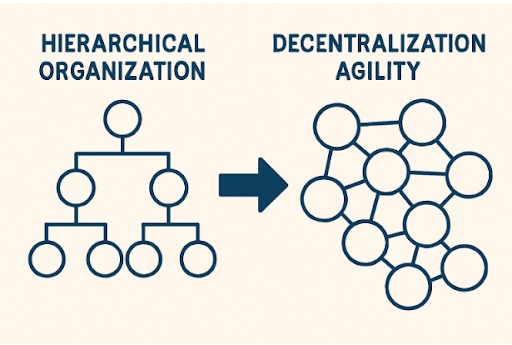
One of the most pronounced shifts in organization design is the movement away from rigid, hierarchical structures toward decentralization. Rigid, top-down hierarchies often hinder both decision-making speed and grassroots innovation, leaving organizations vulnerable during periods of upheaval. With decentralized structures, organizations empower smaller, more autonomous teams who are closest to the action. This model allows for faster responses to emerging challenges and makes adaptation an ongoing process rather than a delayed reaction.
Research from Harvard Business Review highlights that companies with flatter, networked designs consistently outperform peers in volatile conditions by harnessing insights from across the workforce. Real-world examples abound, such as the adaptability demonstrated during the COVID-19 pandemic, when organizations that granted autonomy to local managers and frontline staff adapted processes to meet evolving requirements and customer needs far more effectively than centralized counterparts.
Initiatives designed to foster decentralized communication do not happen overnight. Building an agile, adaptable organizational structure takes time, focus, and a willingness to experiment with new ways of working. Leaders must be intentional in defining the guiding principles that empower teams, such as clarity on decision rights, the scope of autonomy, and how accountability is distributed throughout the enterprise. Regularly revisiting these principles ensures that the decentralized approach continues to align with strategic objectives as both internal and external conditions shift. In organizations where decentralization is celebrated, there is not only increased agility but a stronger sense of ownership and engagement among employees. These benefits directly translate to quicker pivots, more rapid identification of new market opportunities, and heightened organizational learning over the long term.
Integrating Digital Technologies for Resilience
Digital transformation has become a cornerstone of contemporary organization design. The strategic application of artificial intelligence, machine learning, and blockchain allows businesses to better predict market shifts, automate decision-making, and reinforce supply chains. A study published in the International Journal of Information Management underscores how digital technologies bolster organizational resilience, enabling businesses to sustain superior performance even in crisis situations.
True integration of digital technologies goes well beyond investing in new tools. It requires building digital literacy, creating cross-functional teams, and embedding data-driven decision-making into the fabric of the business. For example, leveraging AI-powered analytics can help organizations spot risk signals early and enact swift, informed countermeasures, turning potential threats into opportunities for innovation.
Empowering employees at all levels to use digital platforms and insights can also enhance internal transparency. When teams have access to timely information, they can proactively contribute to resolving issues and seizing opportunities. Furthermore, integrating technologies like remote collaboration tools has proven essential for maintaining productivity and connectivity, especially during unexpected disruptions.
Continuous Adaptation and Learning
The most resilient organizations make learning and adaptation an ongoing, integral part of their culture. One effective practice is the After-Action Review (AAR), which brings teams together after projects or disruptions to discuss what worked, what failed, and how processes can be improved. This cyclical learning not only sharpens competitive instincts but also fosters transparency and accountability across the organization.
According to Forbes, resilient leaders see resilience itself as a core design principle. By prioritizing learning, they ensure that teams are not just ready for change but actively seeking better ways of working, product development, and customer engagement. Employee development programs, regular knowledge sharing, and processes for rapid experimentation all contribute to an environment where people are empowered to anticipate and respond to evolving challenges.
Fostering curiosity and adapting lessons learned from both successes and mistakes are keys to building this agility at scale. Companies that incentivize innovation and encourage risk-taking within safe boundaries often experience a stronger sense of trust and adaptability among their workforce. They are prepared not only to respond to disruptions but to turn them into competitive advantages through continuous growth and process refinement.
Case Study: VARIUS GROUP’s Strategic Reinvention
VARIUS GROUP exemplifies what it means to embrace strategic reinvention. Confronted with dramatic industry shifts, the company refused to rely on old business models and instead undertook bold initiatives that would distinguish it as a leader in its niche. VARIUS GROUP created the world’s first blockchain-based postage stamp, opening new avenues for security and authenticity in collectibles and logistics. The development of Vzual, a 3D proofing tool for the card industry, further showcased its commitment to digital innovation.
These moves were more than reactions to challenges; they were calculated efforts to redefine the company’s market position. By prioritizing a forward-thinking organization design, VARIUS GROUP not only solved immediate threats but also laid a foundation for sustained relevance and leadership in the secure printing and card production fields.
The company’s journey illustrates how embracing modernization and digital transformation can result in a competitive edge, opening up pathways that otherwise would have remained inaccessible. Other organizations can draw valuable lessons from VARIUS GROUP’s success: calculated risk-taking, a focus on strategic differentiation, and the willingness to invest in new capabilities are essential for enduring in rapidly changing industries.
Conclusion
Modern organization design serves as the bedrock for long-term business resilience. Companies that adopt decentralized structures, prioritize digital integration, and foster a culture of adaptation are better equipped to handle disruptions and capitalize on emerging opportunities. By consistently embedding resilience as a principle of design, businesses set themselves up for enduring success and innovation, ensuring they do not just survive in dynamic markets but also thrive and lead.
As organizations continue to face swift and often unpredictable market changes, investing in adaptive design strategies is no longer optional but necessary. The organizations that commit to ongoing reinvention and uphold resilience as a standard across every layer of the company will be best positioned to turn uncertainty into growth, ensuring relevance and prosperity for many years to come.